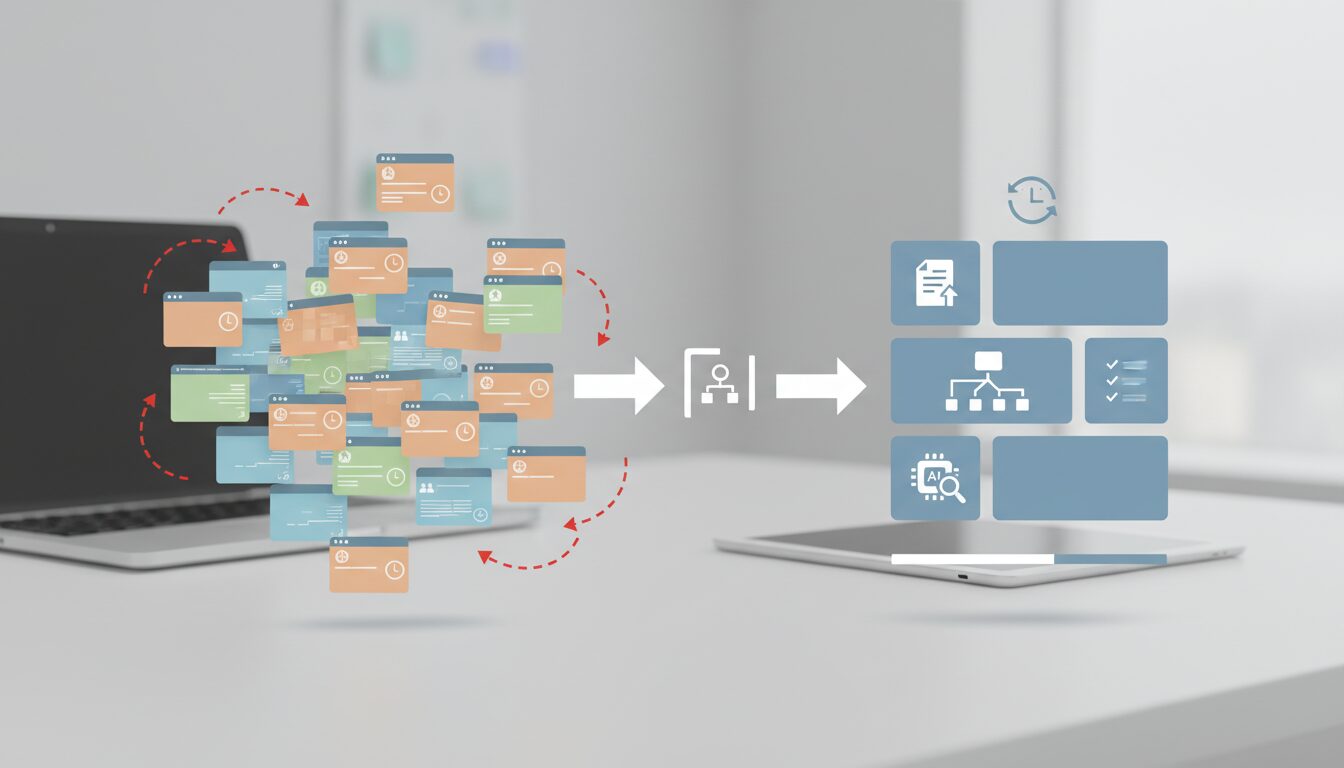
Every time a team member transitions roles or leaves, there’s a silent threat to productivity: the loss of critical knowledge. Without a robust handover process, projects stall, new hires struggle, and the team wastes valuable time deciphering past work. It’s not just about passing on tasks; it’s about preserving institutional memory and ensuring seamless business continuity. Learning how to simplify work handovers is crucial for any efficient team.
How can you transform chaotic job transitions into smooth, efficient knowledge transfers that keep your projects moving forward seamlessly?
Quick summary for busy readers:
- Standardize templates and visualize processes to create clear, actionable handover documents that prevent knowledge gaps.
- Leverage AI tools to quickly summarize information, draft outlines, and extract key details, saving significant time and effort.
- Avoid common pitfalls like vague details, outdated information, or skipping direct Q&A to ensure a truly effective and stress-free transition.
Simplify Work Handovers Easy essentials
In practice, Simplify Work Handovers Easy is most useful when you match the tool to the task instead of expecting one tool to do everything equally well.
The Foundation: Standardizing Your Process to Simplify Work Handovers
To truly simplify work handovers, start by building a consistent and clear framework. This ensures that no critical information is missed and sets a high standard for documentation across your team, making every transition an easy step.
-
Standardize Handover Templates: Create consistent templates for all handovers. Tools like Google Docs, Notion, or Confluence are excellent for this. Your template should include essential sections such as ‘Current Projects/Tasks,’ ‘Key Contacts,’ ‘Access Details,’ ‘Recurring Responsibilities,’ ‘Pending Items,’ and ‘Known Issues.’ This comprehensive approach helps ensure that every critical piece of information is covered, making it easy for the incoming person to hit the ground running and truly simplify work handovers.
-
Document Key Processes with Visuals: For critical or complex tasks, outlining step-by-step procedures in text alone isn’t always enough. Incorporate screenshots, flowcharts, or even short screen-recording videos to clarify workflows. These visuals greatly enhance understanding and reduce ambiguity. Store these visual guides in a shared drive or knowledge base where they are easily accessible and searchable, contributing to an easy handover process.
Smart Tools for Easy Work Handovers: Leveraging AI
Artificial intelligence isn’t just for tech companies; it’s a powerful ally for any office worker looking to streamline and enhance the efficiency of creating handover documentation. AI can make the process faster and more thorough, helping you simplify work handovers with ease.
-
Summarize Long Documents: Instead of spending hours sifting through lengthy project briefs or reports, use an AI tool (like ChatGPT, Bard, or Copilot) to distill the information. This helps you quickly create concise handover summaries, highlighting key objectives, current status, and next steps relevant for the incoming team member. This is an easy step to save time.
Prompt example: ‘Summarize this project brief into a concise handover document, highlighting key objectives, current status, and next steps for a new team member.’
-
Draft Initial Outlines: Getting started can be the hardest part. AI can generate a structured handover document outline tailored to specific roles, ensuring all relevant areas are comprehensively covered. This saves significant time and ensures consistency, making it an easy step towards a complete document.
Prompt example: ‘Generate a handover document outline for a marketing specialist role, including sections for ongoing campaigns, social media management, and reporting tools.’
-
Extract Key Information: AI can quickly pull out action items, responsible persons, and deadlines from meeting notes or project communications. This saves hours of manual review and helps ensure critical details are not overlooked in the handover, further helping to simplify work handovers.
Prompt example: ‘From these meeting notes, extract all action items, responsible persons, and deadlines relevant for a project handover.’
Centralization & Collaboration: Making Knowledge Accessible for Smooth Handovers
Effective handovers aren’t just about creating documents; they’re about making sure that knowledge is easily accessible and that there’s direct interaction to clarify any nuances. This fosters a collaborative environment and truly helps simplify work handovers.
-
Centralize Your Knowledge Base: Store all handover documentation, process guides, and relevant resources in one easily accessible, shared platform. Tools like SharePoint, Confluence, Notion, or Google Drive are ideal for this. Ensure proper access permissions are set so that incoming team members can find what they need without delay. A centralized system prevents information from getting lost in individual inboxes or local drives, ensuring business continuity and an easy handover experience.
-
Schedule Dedicated Overlap and Q&A: Documentation is crucial, but it’s rarely enough on its own. Plan specific, protected time for the outgoing and incoming team members to review the documentation together. Encourage interactive Q&A sessions. This direct interaction allows for clarification of nuances, discussion of ‘unwritten rules,’ and provides invaluable context that documents alone cannot convey. This dedicated time significantly reduces the ramp-up period for the new person, making the transition an easy step.
Avoiding Common Pitfalls for Easier Work Handovers
Even with the best intentions, work handovers can go wrong. Understanding common mistakes and how to prevent them is key to a successful transition, minimizing disruptions and frustrations. These are the areas where handovers often break down, and how to fix them to simplify work handovers.
-
1. Insufficient Detail or Vague Information:
Why it breaks: The handover document lacks specific instructions, access credentials, or context. The incoming person cannot perform tasks independently, leading to constant interruptions, delays, errors, and frustration. They might miss critical steps or context.
Prevention: For each task, use the ‘five Ws and one H’ (Who, What, When, Where, Why, How). Include specific access details (managed securely, of course), contact persons for specific areas, and the rationale behind key decisions. AI can even help review your document for clarity:
Prompt example: ‘Analyze this handover document and suggest areas where more specific details or examples would be beneficial for a new team member.’
-
2. Outdated or Inaccessible Documentation:
Why it breaks: Information is incorrect, irrelevant, or stored in disparate, hard-to-find locations. The incoming person wastes time searching for information or relies on incorrect data, leading to rework, missed deadlines, and a breakdown of trust in the documentation.
Prevention: Store documents in a centralized, cloud-based system with robust version control. Implement a mandatory review schedule for critical documents (e.g., quarterly or at project milestones). Consider integrating AI tools that can flag outdated information by comparing document content with recent project updates or communication logs, prompting you to review and update, thus making it an easy step to maintain accuracy.
-
3. No Dedicated Handover Time or Lack of Direct Interaction:
Why it breaks: The outgoing person rushes the handover, or the incoming person is expected to learn solely from documents without any direct Q&A or walkthrough. Documentation alone often misses the nuanced ‘why’ behind decisions, unwritten team norms, and critical context that only direct interaction can provide. This leads to misunderstandings and a slower ramp-up.
Prevention: Schedule dedicated, protected time for a comprehensive handover meeting. Encourage interactive Q&A sessions. The outgoing person should walk through the documentation and demonstrate key processes. For complex tasks, consider recording short walkthroughs. Make this meeting a priority, not an afterthought, to truly simplify work handovers.

Checklist for Effective Handovers:
- Have you created a standardized handover template for your team?
- Are critical processes documented with visuals (screenshots, flowcharts, videos) for clarity?
- Have you explored using AI to summarize long documents or draft initial outlines for efficiency?
- Is all handover documentation stored in a centralized, easily accessible knowledge base with proper permissions?
- Is there a scheduled, dedicated overlap time for direct Q&A between outgoing and incoming team members?
Viewing work handovers as a critical investment, not a chore, will fundamentally shift your team’s efficiency. Embrace technology, especially AI, to automate mundane tasks and enhance clarity. Prioritize concise, regularly updated documentation, and foster a culture where proactive knowledge transfer is a routine part of every project and role. These easy steps will simplify work handovers significantly. Your future self, and your team, will thank you for the seamless transitions.
- [1]
Google Workspace Learning Center
Official guidance for reducing repetitive work