
When you need to decide quickly in real work, the useful choice usually depends on the task itself rather than the tool name.
Crafting Click-Worthy Blog Titles for Professionals
You’ve spent hours, maybe even days, crafting an insightful article packed with industry-specific solutions. You hit publish, expecting engagement, only to see it get a handful of clicks. The hard truth is that even the best content will fail if its title doesn’t stop a busy professional mid-scroll. Your title is not just a label; it’s the single most important piece of marketing for the content you worked so hard to create.
Quick summary for busy readers
- Focus on clarity and specific benefits; a title like ‘How to Cut Meeting Time by 50%’ always beats a vague one like ‘Unlocking Synergy’.
- Integrate relevant keywords naturally to ensure your content is discoverable by professionals actively searching for your expertise.
- Avoid ‘professional clickbait’—overpromising in your title erodes trust and damages your credibility faster than any other mistake.
How can you write a blog title that not only grabs the attention of a professional audience but also respects their time and intelligence? It’s about making a clear promise of value.
For those short on time, here’s the core strategy:
- Focus on clarity and specific benefits. A title like “How to Cut Meeting Time by 50%” always beats a vague one like “Unlocking Synergy.”
- Integrate relevant keywords naturally. This ensures your content is discoverable by professionals actively searching for your expertise.
- Avoid “professional clickbait.” Overpromising in your title erodes trust and damages your credibility faster than any other mistake.
Crafting Click Worthy Blog: what to focus on first
In practice, Crafting Click Worthy Blog is most useful when you match the tool to the task instead of expecting one tool to do everything equally well.
The Foundation: Define Your Core Message and Audience First
Before you even think about a title, you need to be crystal clear on two things: what you’re saying and who you’re saying it to. A strong title is impossible without a clear purpose. Trying to write a headline without this foundation is like trying to build a roof before the walls are up.
Start by answering these simple questions:
- What is the single main point of my article? Summarize your entire post into one powerful sentence. This is your core message. If you can’t do this, your article may lack focus, and no title can fix that.
- Who is my ideal reader? Be specific. Are you writing for junior project managers, C-level executives, or senior software developers? Each audience has different pain points, priorities, and language. A title for a CEO should focus on strategy and ROI, while one for a manager might focus on team efficiency.
- What specific problem does this article solve for them? Professionals read content to solve problems. The answer to this question is the heart of your title. It’s the value you are promising to deliver.
The 5-Step Formula for Crafting Click-Worthy Titles
Once you have your foundation, you don’t need to stare at a blank page. Follow this practical, repeatable process to move from an idea to a polished, effective headline.
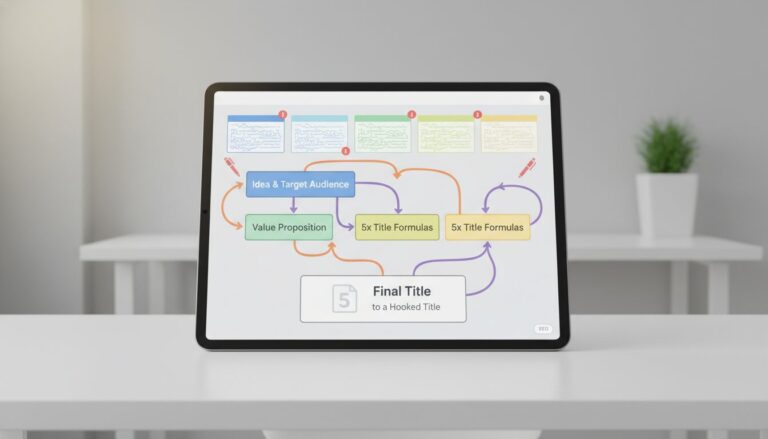
Step 1: Conduct Targeted Keyword Research
Think like your audience. What words or phrases would they type into a search engine to find your solution? You don’t need complex tools to start. Type a few ideas into Google and see what auto-completes. These suggestions are based on what real people are searching for. Your goal is to find a primary keyword that accurately reflects your topic and integrate it naturally into your title.
Step 2: Apply Proven Title Formulas
Don’t reinvent the wheel. Use established formulas as a starting point to structure your ideas. Here are a few that work well for professional audiences:
How to [Achieve a Specific Goal] in [Timeframe/Method]
Example: How to Onboard a New Hire Remotely in One Week
[Number] Actionable Tips for [Solving a Common Problem]
Example: 7 Actionable Tips for Reducing Team Burnout
The Ultimate Guide to [Complex Topic]
Example: The Ultimate Guide to B2B Content Marketing Strategy
Step 3: Draft 5-10 Variations
Your first idea is rarely your best. Force yourself to write at least five different titles. This exercise pushes you beyond the obvious and helps you explore different angles. Try framing one as a question, another as a direct benefit, and another as a “how-to” guide. The more options you generate, the better your final choice will be.
Step 4: Refine and Select
Read your list of titles aloud. Which one sounds the clearest and most compelling? Which one would make you stop scrolling through a busy feed? For a more objective take, you can use a free online headline analyzer. These tools score your title on factors like readability, clarity, and emotional impact, giving you useful feedback for refinement.
Step 5: Check the Length
Your final title should be under 60 characters. This isn’t an arbitrary rule; it’s the approximate limit before search engines like Google cut it off in the search results page. A truncated title looks unprofessional and hides the full value proposition from your potential reader.
3 Common Mistakes That Kill Engagement (And How to Fix Them)
Even with a good process, it’s easy to fall into common traps. Here are the three biggest mistakes that undermine great content and how to fix them immediately.
Mistake #1: Being Vague or Overly ‘Creative’
Corporate jargon and abstract concepts mean nothing to a busy reader. They can’t quickly determine “what’s in it for me,” so they scroll right past.
- Instead of this:
Unlocking Synergy for a Better Workflow
- Fix it with this:
How to Cut Your Meeting Time by 50% With the ‘Agenda-First’ Method
The fix is to replace vague promises with concrete, measurable outcomes.
Mistake #2: Forgetting SEO and Your Audience
Writing a title without thinking about search terms makes your content invisible. Your expertise never reaches the people actively looking for it.
- Instead of this:
My Thoughts on Recent Security Changes
- Fix it with this:
5 Essential Cybersecurity Tips for Remote Teams in 2024
The fix is to weave relevant keywords your audience uses into a title that also offers clear value.
Mistake #3: Overpromising (Professional Clickbait)
A title that sets an impossible expectation erodes trust. When the content offers standard advice, it damages your credibility and makes readers feel cheated.
- Instead of this:
This One Secret Will Double Your Revenue This Quarter!
- Fix it with this:
7 Data Storytelling Techniques to Make Your Presentations More Persuasive
The fix is to be specific and realistic. Promise a tangible skill or insight, not an unbelievable outcome.
Your Final Title Checklist
Before you hit publish, run your final title through this quick checklist:
- Does the title clearly communicate the article’s value in under 8 seconds?
- Does it include a primary keyword your target professional would search for?
- Is the title an accurate promise that the content can deliver on?
- Is it specific and benefit-driven, rather than vague or generic?
- Is it under 60 characters to avoid being truncated in search results?
Your blog title is the single most important sentence you’ll write for any piece of content. It’s not an afterthought; it’s the promise you make to a busy professional. Treat it with the same care and strategic thinking as the content itself, and you’ll earn not just their click, but their trust and attention.
- [1]
Google Docs Help
Official help for drafting and revising text